Wednesday, January 29, 2014

More on TCR

The Comic Reader was a source of news and information on upcoming product from a variety of publishers, as well as a lively forum for fans with articles and a letter column. They also kept in contact with many professionals, leading to artwork specially prepared for the publication.

 
The talented Russ Manning not only kept TCR informed of his work on various features for Western Publishing, including Magnus, but provided artwork as well. Cover of The Comic Reader # 34, February 1965. This issue also mentions in the news section that "Marvel MIGHT put out a book concerning Sgt. Fury's activities as a spy after the war, patterned after the Man From UNCLE. Instead of Thrush they'd have Hydra!" . They were correct, of course, and about four months later Fury replaced The Human Torch in Strange Tales.


The Comic Reader # 35, March 1965 took a look at some of the results of the 1964 Alley Awards. Spider-Man and FF were very popular with fans, but surprisingly, Hawkman was third runner up, not one of DC's bigger stars. Marvel and DC were not singled out either. ACG's Forbidden Worlds won the Best Regularly Published Fantasy Comic; Russ Manning was second favorite pencil artist (Infantino was # 1, followed by Kirby, Murphy Anderson and Kubert) and best humorous comic was ACG's Herbie, followed by Uncle Scrooge. Other awards (not shown above) included Strip most desired for revival, with a distinct emphasis on DC's 1940s heroes, including Spectre, Dr. Fate, Dr. Mid-Nite, Justice Society, and Fawcett's Captain Marvel. In the years ahead many fans wishes were fulfilled in one form or another. Best new strips included Captain America, Daredevil, Hawkman, Elongated Man and Jungle Tales of Tarzan. Charlton published an unauthorized series (they apparently believed Tarzan to be in the public domain) which ran four issues. Edgar Rice Burroughs inc. reportedly filed an injunction against Charlton, who had a fifth issue,"on the presses" according to a news item in TCR #39. Did any of these issues survive, or were they all pulped? 


Steve Ditko provides the cover to TCR # 36, April 1965, foreshadowing his return to Charlton. This was simultaneous with Charlton reprinting Capt. Atom stories. The news section explains "...if it catches on Steve will probably be asked to continue the series." concluding with "I hope Steve has the time to work for two companies." 


Fan artist Ron Foss provides the back cover illo promoting the second NY Comiccon in 1965, run by Dave Kaler. One aspect of the early comic book conventions that remains popular - as anyone who attends in the present day knows - is the costume contest. More clear than the drawing is the postal stamp, dated April 17th, and the 10 cent stamp!


 A nice Dick Ayers drawing of the Human Torch (who he was drawing or inking at the time) graces the cover to The Comic Reader # 37, May 1965. The inside front cover notes that Ayers drew this for fan Kent Russell. Don't try reading the fading purple type unless you want to wind up like the near sighted Mr. Magoo!  


 A big announcement from Charlton editor Pat Masulli, one of the first to seek out fans to write comics. Masulli would keep is word, as we shall soon see. Another interesting note at the bottom of the news column says that Masulli will sell original art for $25.oo a page to "qualified collectors only". Did any fans in that period buy art from Masulli? Was he "authorized" to sell the art which many believed was destroyed ? Was he selling art covers that he drew (Masulli was an artist as well as an Editor). Did Charlton management know or care?    

Another interesting news item is the information on future issues of Spider-Man. Since issue # 27 would have been out at the time of this announcement, and Ditko and Lee were not speaking, the news apparently came directly from Ditko (who is often credited in the news sources on page 2, although not in this issue). This is direct proof of how far ahead Ditko was plotting Spider-Man: mention of "the Octopus" (obviously DR. Octopus, referring to the Master Planner storyline) and the Meteor Man, who would not appear until issue # 36, some nine months later. 


 The 38th issue of The Comic Reader (June 1965) announced Roy Thomas' first pro work for Charlton, which appeared in Son of Vulcan # 50, January 1966. As noted in the article, Roy planned to have Son of Vulcan meet Blue Beetle and Capt. Atom, but issue # 50 was the last issue. Roy might have been able to team-up the heroes in Blue Beetle, since he wrote #50 (Feb-March 1966), but THAT title succumbed to poor sales as well! Don't feel too bad for Roy, though. Although his career at Charlton was short-lived, I've heard he's written a few comics since then....


Charlton heralds a new writer from the world on fanzines on the cover of Son of Vulcan #50. Although Roy Thomas didn't get his name mentioned on the cover, a month earlier Dave Cockrum, who would soon become a prolific fan artist and later pro, was - for costume ideas. That creativity served him well a few years hence, designing costumes for the Legion of Super Heroes and the revised X-Men. Bill Fraccio pencils; Tony Tallarico inks. Image from the GCD.      
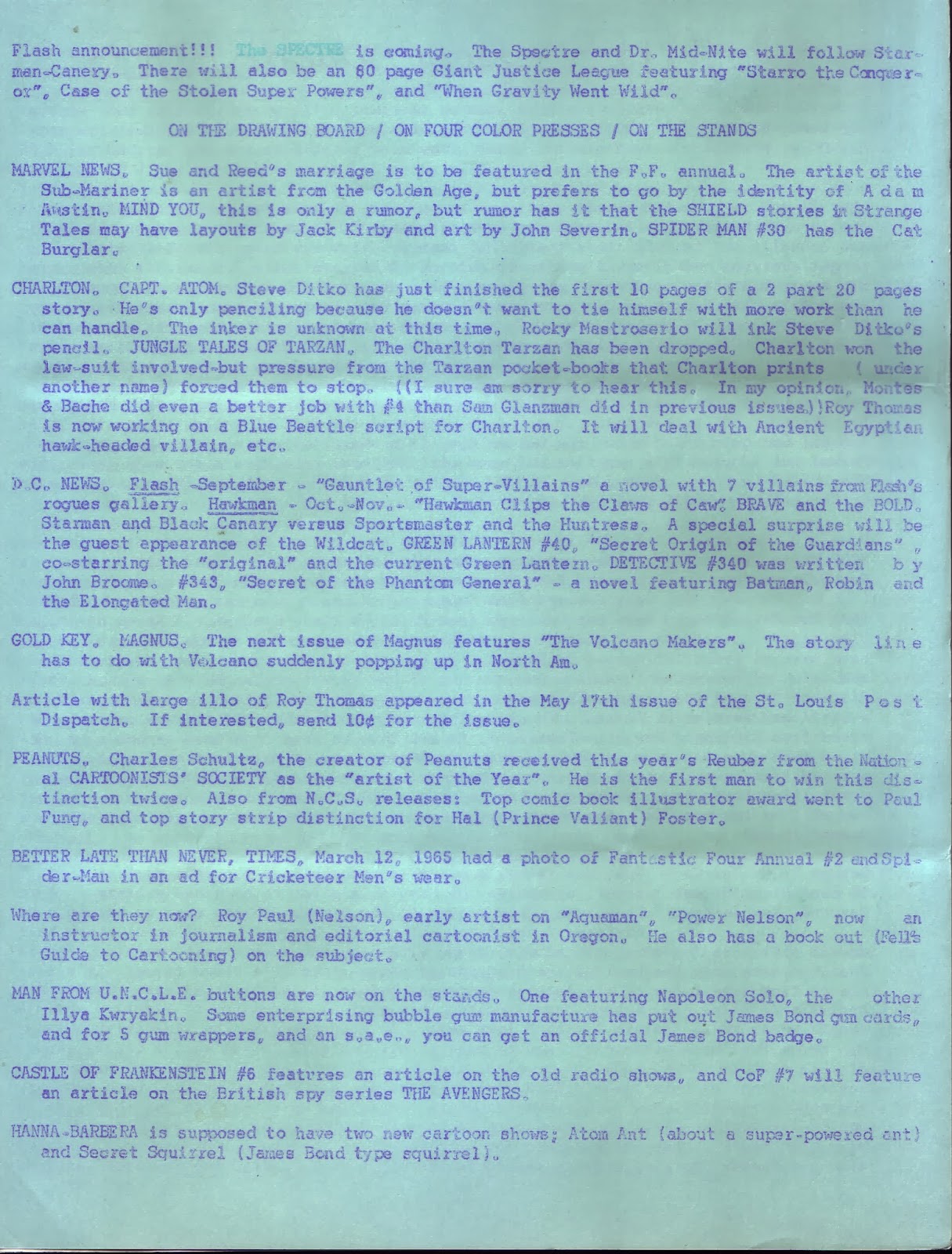


Ditko returns to drawing Capt. Atom for Charlton (this time credited as a news source on the second page) while continuing at Marvel on Spider-Man and Dr. Strange. Errors occasionally slipped in - one sentence states the inker is unknown and the next announces Rocke Mastroserio. As noted earlier, the info on Jungle Tales of Tarzan here is probably wrong. The later news item was confirmed by one of the Burroughs family and Pat Masulli.  The Comic Reader # 38.    
          

DC editor Murray Boltinoff was a friend of many fanzine editors and the source of news items. He also read articles related to his titles as the letter explains. From the "Quotes From the Readers" section of The Comic Reader # 39, July 1965. 


Also from TCR # 39: Bill Dubay drew these "Picto-Origins" which were illustrated histories of Timely characters in fanzines such as TCR and his own Yancy Street Journal. About six months later, in Yancy Street Journal # 12 (Jan 1966) new Editorial Assistant Roy Thomas informed DuBay that Marvel could not give him permission to continue the picto-origins. Roy explained: 

"While Stan and I certainly have no personal objections to the series, which is quite well-handled by Bill Dubay, the entire affair is strictly a legal matter." 


Speaking of Roy Thomas, the On The Drawing Board section of TCR # 40, Aug 1965, announces his joining Marvel. Other "Bombshell Announcements" include Tower Comics starting up, Charlton's new Thunderbolt comic and Simon and Kirby Fighting American reprints from Harvey.  


The cover to The Comic Reader # 41, Sept 1965, features another Russ Manning illo, this time of Tarzan which he had recently taken over. 


That issues On The Drawing Board has probably the first mention of Jim Steranko. Although he didn't get a job with Stan Lee the first time around, Steranko picked up some work from Joe Simon at Harvey, where he created characters such as Spyman. A year or so later he was given the Nick Fury feature in Strange Tales to draw, and soon write, making a name for himself as a dynamic new talent. Dave Kaler was another fan turned pro that Charlton Editor Pat Masulli hired. Although the Son of Vulcan story mentioned never appeared since the book was cancelled, Kaler went on to write Capt. Atom and assorted features for the company. Did Tom Fagan ever write anything for Charlton?


Sal Trapani was another artist/inker who added some background info on himself and his work with Dick Giordano. From TCR # 41.

Issue 41 had another interesting news item concerning fan writers and Charlton.


Dave was apparently working on Son of Vulcan # 51, but, as noted earlier, it was cancelled. However it was in production and pages exist, as seen here:


The Blue Beetle has a cameo appearance and a recent issue is referenced. This may have been Roy Thomas' idea. I asked Roy, who doesn't recall  his exact involvement, but believes it was indeed Dave Kaler who scripted that issue, with some editing/assistance by him. Kaler went on to script some of Ditko's Capt. Atom stories, along with fillers such as Dr. Graves appearing in Ghostly Tales.


Derrill Rothermich took over the editing/publishing of the TCR with issue # 42, October 1965, and a noticeable improvement was the switch to offset printing, creating a much clearer look. This is the complete Sal Trapani Nukla drawing, with inking likely by Dick Giordano (thanks to Mike DeLisa for pointing that out) that appeared in truncated form in the previous issue.    


From the same issue, Paul Reinman adds a little background about Archie's Mighty Comics Superhero line of which he was the primary artist.


And we close out with not one, but TWO items from Steve Ditko in the very same issue! This illo is again from fan Kent Russell, who had earlier provided the Ayers Torch drawing. Kent was certainly getting some wonderful artwork from the pros. Apparently this was an older Ditko drawing, since Dr. Strange is attired in his earlier cape and Spidey looks less muscular than he was currently drawn.    


Ditko also wrote a letter to TCR in response to their requests for background on him. Ditko points out that he had an uphill battle, seeking work in comics for three years and "just as regularly got turned down." One area worth pointing out is Ditko stating that he worked with other inkers on Harvey's 3D line. We know he assisted Simon and Kirby on Captain 3-D # 1, as well as the unpublished # 2, but did he assist on any other 3D comics for Harvey?   

                        More explorations on The Comic Reader coming soon... 


Friday, January 24, 2014

Gems in early Fanzines - The Comic Reader

The early fanzines had a charm, enthusiasm and energy that continues to fascinate me. So many of the pioneers produced work that is historically important and filled with the essence of youth, a wide-eyed spirit that filled many ink stained pages. There are many gems sprinkled throughout the aging, small-press fanzines (some with a print run of 300 or less) and I thought one of the most important, The Comic Reader, would be a good place to start.

The father of fanzines, Jerry Bails is worthy of praise for producing Alter- Ego alone, but his accomplishments are many and varied. After passing AE to Roy Thomas, Bails produced the Comicollector and On The Drawing Board, which included comic book news and information of the pros. Bails discussed his early contributions in Bill Schelly's exceptional book, Comic Fandom Reader:

"My initial conception of Alter-Ego turned out to be unrealistic. I wanted well-researched articles and features, comic strips, news, and ads. Each of these features demanded different deadlines. The Comicollector was the first spin-off in September 1961. Eventually the "On The Drawing Board" news feature became a separate newsletter, which later evolved into The Comic Reader. All of these publications had a life long after my tenure, each becoming more and more professional over the years."       


A page from an early issue of The Comic Reader, possibly # 25, has two pages of news items on Marvel, DC, Dell and Charlton, as well as magazine related comic book articles. George Tuska's announcement as new artist on the Human Torch was premature - although he drew a few stories for Marvel early on, he would not return full  time until 1967, as inker and soon long-time artist on Iron-Man. Dick Rockwell also never went on to Giant-Man, replaced by a Steve Ditko fill-in (Tales to Astonish # 61, Nov 1964)    


TCR had many interesting features and often contacted creators, many of whom were surprised and flattered by the attention. On this page from TCR # 27 July 1964 (now taken over by Glen Johnson), aside from items on Frank Thorne, DC's Phantom Stranger and Curt Swan, there is background info by Chuck Cuidera and Joe Certa, both solid artists who had long careers in comic books. It's a pleasure to discover a little about Certa's career. In later years many of the old pros were ignored, with emphasis on the latest fan favorite, an opportunity missed that, in many cases, can never be rectified.    


In addition to his work for DC on a variety of features, notably John Jones, Manhunter from Mars, Joe Certa drew a variety of features for Gold Key over the years, including a long run on Dark Shadows, based on the popular ABC daytime soap opera.Don Arneson script, Ben Oda letters, from Dark Shadows # 5, May 1970.


With contacts throughout the industry, including Nelson Bridwell, Julie Schwartz, Jack Schiff, Murray Boltinoff, Pat Masulli, Ray Miller and Russ Manning, TCR had a good deal of accurate information and the ability to report on much of the industry. We're still waiting for that Harlan Ellison Hawkman story, though! From The Comic Reader # 30, October 1964


 Displaying a fair-minded and thoughtful personality even when he was a fan, Roy Thomas makes his case in a letter from TCR # 30    


These two pages from TCR # 32, Dec 1964, are one of the most important facets of early fandom. Where else could one find information on the Dell creators, who were rarely credited in the comics? Here we get information on not only the artists, but writers, cover painters, letterers and colorists. I've discovered much while perusing through the early fanzines, and it is a credit to those early fans that they were interested in the diversity of writers, artists and companies.


Not only were editors generous with their time, many artists were too, taking the time out of their busy schedules to draw for a small press publication. Steve Ditko was one of the most generous and here he does an excellent rendition of Spider-Man and Dr. Strange, from the Comic Reader # 33, January 1965. There will be more Ditko and more on The Comic Reader, coming soon. 


Wednesday, January 8, 2014

In Appreciation

I thought I’d break tradition this time out and pay tribute to the person who first spurred my interest in comic books: my brother John. John is seven years older than me, and was buying comics before I was born. I can't remember a time when comics weren't in the house. When I was a tyke John was buying Marvel’s on a regular basis, particularly the superhero line. John didn't only buy Marvel's though, he also purchased DC (John particularly liked group titles such as Challengers of the Unknown, Doom Patrol and Blackhawk);Gold Key, Charlton, Tower and Archie’s “Mighty Comics” line.


 FF #20 may well be my introduction to Jack Kirby's art. It was the earliest issue in John's collection, and while I wouldn't describe the art as pretty, it had a rough around the edges quality that held my attention. Inside, equally ominous characters like the Watcher awaited, and I was hooked. Kirby pencils; George Roussos inks; Artie Simek letters and likely Stan Goldberg colors. Fantastic Four # 20, November 1963. 


John started his Spider-Man collection with # 3, and how could this scene not get a child's attention? Ditko's odd-looking hero and mysterious villain was - again - more than likely my first exposure to Ditko's individualistic style. His faces, figures and scenes all had a distinctive personality, and to this day Ditko's work remains an ongoing source of study and appreciation. Amazing Spider-Man # 3, July 1963, Steve Ditko art, Artie Simek letters, Stan G colors?


 The first issue of Suspense John had, if memory serves me correctly (and my memory is usually better than John's) has no Iron-Man on the cover! Instead we have an inset of Tony Stark putting his suit on, while the villain attacks. Perhaps not the most dynamic of covers, but with a certain charm. Kirby pencils; Dick Ayers inks; Artie Simek letters; Stan G colors? Tales of Suspense # 46, October 1963

 Before I could read I would stare at the covers and interior artwork by the likes of Jack Kirby, Steve Ditko and Wally Wood. In 1966, at the age of six, I began reading the stories and they had me hooked, particularly Stan Lee’s writing, with it’s touches of humor and drama; and the sense of enthusiasm he was capable of transmitting to the printed page. The continued stories were a real thrill, especially to a child, when 30 days seemed like an eternity. You could pick up a DC at almost anytime and enjoy it on its own merits, but continued stories were rare in that period. Marvel, with its cliffhanger endings and sub-plots were addictive - you HAD to buy the next issue to find out what happened, and John rarely missed an issue.

With little publicity and no news outside of  promotional ads and bullpen pages, there was an immediacy to buying new comics that is hard to describe. Every week we would travel to various newsstands and candy stores in the neighborhood (no comic shops then), either separately or together, to pick up the latest comics. As I got older John and I both discovered fanzines and subscribed to the Comic Reader and the Buyers Guide. We would discuss the new books coming out, what titles were getting cancelled and our favorite writers and artists. John also took me to my first comic book convention, probably in 1970. It was a Phil Seuling Con, but all I remember are tables full of comics and lots of people. We came home with a shopping bag of comics, which we had to sneak into our house lest our parents find and confiscate them.


John has always enjoyed team books, including the Challengers. This is one of the earliest issues I recall. Bob Brown pencils; Brown inks? Challengers of the Unknown # 42, February-March 1965. Image from the GCD.


 Charlton's were not always easy to find in our neck of the woods, Brooklyn in the 1960's, although they might pop up in a dusty corner of John's Bargain Store (a variety store akin to the 99 cent stores of today). Some of John's acquisitions were Blue Beetle, Capt. Atom and Thunderbolt. Distribution improved in the early 1970's and John bought many of Charlton's Ghost line, particularly those with covers by Steve Ditko. Thunderbolt # 1, January 1966. Pete Morisi art.


Archie Comics blatantly copied Marvel's corner design with their short-lived "Mighty Comics Group", which reportedly infuriated Marvel's publisher, Martin Goodman. I have a soft spot for the quirky "Mighty Heroes" mainly due to Paul Reinman's artwork. Cover art by the aforementioned Reinman, from Fly Man # 36, March 1966 


The brilliant artistry of Wally Wood was an immediate attention getter to John and Nick C. Wood cover to Dynamo # 2, March 1967

John was also instrumental in starting my love for comics’ history. Come Christmas or my birthday John would give me gifts such as Steranko’s History of the Comics and Superman and Batman from the 30’s to the 70’s, hardcover books reprinting early exploits of the heroes. I began to relish learning about writers, artists, publishers and all that came before: the Timely era, DC, Fawcett and Captain Marvel, EC and many others. I still have those books in my collection, as well as a beat-up (but treasured) paperback of All in Color for a Dime (which my Mom bought for me). As I got older I returned the favor and bought comic related books for John, and we always shared our stuff (and still do, even though he likes to give me a hard time whenever I raid his collection!)
                                           

It was wonderful to read the early stories of Superman and Batman at a time when reprints were scarce. Superman from the 30's to the 70's, which I may have received in Christmas of 1970. 

Older brothers can be a pain in the neck sometimes, but not only did John buy and share all his comics when I was a little runt, he instilled a deep interest in movies. Although John is a huge sci-fi fan, he appreciates all types of movies, and that diversity could be seen on Television, where crime, western, comedy and dramas were available, as well as old serials and shorts like Laurel and Hardy and the Three Stooges. We also had great old cartoons like the Fleischer's Popeye cartoons. Back in the pre-VCR/DVD days you had to stay awake at night to see a particular movie – you never knew when it would air again. Local television in NY showed plenty of horror and sci-fi - from Universal classics to Roger Corman low budget thrills. We saw them all, when we weren't reading about them in the pages of Famous Monsters and Castle of Frankenstein.


 The opening to WPIX-Channel 11's Chiller Theater program, the source of many childhood thrills and chills!  


Over the decades John and I have devoured countless books on directors, actors, producers and studios, learning about the history of movies from the silent era to the present day.


James Cagney, a favorite actor that we grew up watching on television


And of course, television was part of our childhood. Dark Shadows was a supernatural soap-opera that had something in common with comics – it was continued and had ongoing sub-plots (along with vampires, witches and werewolves) so we were hooked. At six years old I was completely taken by Batman on TV, but there was much to enjoy for kids and teenagers, including Star Trek, Wild Wild West, Lost in Space, Time Tunnel, Twilight Zone, Outer Limits and many others. Not all hold up in later viewings, but they were fun for their time.


Dark Shadows had its own comic book series from Gold Key beginning in the late 1960's. While vampires were not allowed by the Comics Code until the 1970's, Gold Key was not part of the Code and could present Barnabas and company. A nicely designed and hued cover photo of Jonathan Frid as Barnabas Collins and David Hennesy as David Collins, Dark Shadows # 6, August 1970. 

John also loves music, particularly rock n roll, so I listened to the Beatles, the Rolling Stones, the Supremes, the Turtles, the Young Rascals, the Doors, Cream and many others that I still enjoy, all on 45 rpm records. And all the while we listened to and appreciated the singers and musicians of an earlier era, since folks like Nat King Cole, Frank Sinatra, Jimmy Durante and Tony Bennett sang and preformed on variety shows, sometimes introducing the rock acts we enjoyed. It was a period when everything was not compartmentalized as it is today.

So, to John, who celebrates his birthday today, I thank you for instilling a life-long passion for comic books, which we continue to enjoy, but also for the movies, music and television programs which we've shared throughout our lives. Although our tastes diverge in places, we still laugh and have fun talking about a great many things (when we’re not yelling at each other!) and isn't that something to be thankful for? (Now I hope you don''t expect to get a Birthday present ALONG with all this praise!!)   

Sunday, December 29, 2013

Marvel’s Forgotten Crossovers

When one thinks of Marvel Comics and characters interacting in their shared “world”, many assume this began with the early 1960's super-hero line, when Stan Lee had the Fantastic Four meet the Hulk and Spider-Man. While crossovers clearly grew in the Marvel Age, they didn't begin with them. Lee liked the idea very early on; one of his text features in the 1940’s had the Torch, Captain America and other Timely heroes meeting. The inspiration likely came from several sources. 

On radio the incredibly talented and popular Jack Benny had a friendly "rivalry" with Fred Allen and both occasionally guested on each others shows.


The Battle of the Century! Jack Benny (on the left) and Fred Allen (on the right) were two comedians who were friends since vaudeville days. Their jibes at each other lasted for decades, moving from the radio into Benny's television show.  

In movies Universal pictures successfully paired two of their monsters together in Frankenstein Meets The Wolfman (1943). They followed with more team-ups and genres even collided when Abbott and Costello met Frankenstein.

 
A moody scene from the first (and best of the lot) Universal studios meeting of monsters. Bela Lugosi as the Monster; Lon Chaney, Jr. as the tortured  Laurence Talbot. Both monsters would be an inspiration for Lee and Kirby's Hulk.


 Authors such as Jules Verne had supporting characters appear in different novels, and Edgar Rice Burroughs had Tarzan journey to Pellucidar in one of his novels.


              J. Allen St. John art to the 1930 hardcover edition of Tarzan At The Earth's Core

 Characters in pulps met each other, and television had early examples. In researching I discovered that Ann Southern’s character from Private Secretary met Lucy on the Lucy/Desi Comedy Hour in 1957 (both, not surprisingly, CBS shows). It's also interesting to note that other shows were often referenced on situation comedies such as Bachelor Father or Leave it to Beaver. These are often asides, but they were an easy way to promote other network shows, much like Lee would later promote his line with short captions.   

While super-heroes were often paired together on covers, they rarely met inside the pages. One of the most important exceptions was the confrontations between the Human Torch and Sub-Mariner in the 1940's, but when superheroes faded out in the latter part of that decade, there was little interaction between feature characters. For the most part this continued into the 1950's, although exceptions occurred. One crossover appeared in Combat Casey # 10 (June 1953), where Battle Brady guest-starred in one story (I'm Comin' to get ya, Penny..", illustrated by Robert Q. Sale). Both characters were written by Hank Chapman, which made it a simple procedure. The crossover was not publicized on the cover, and is likely known to only a few Timely-Atlas die-hards (Tom Lammers, who discovered and mentioned the story on the Timely-Atlas Yahoo Groups some years ago being one of them. Thanks Tom!)     


In the early 1960's Stan Lee was inspired to promote the "girl line” of humor comics and did so with gusto.


Millie the Model # 103, July 1961. Before Fantastic Four made it's way to the newsstands the following month, Lee had Patsy Walker guest-star, including a large caption and Chili directly addressing the reader. Stan Goldberg pencils and possible inks/colors (with Al Hartley likely drawing Patsy) and Artie Simek lettering. Image from the GCD. 


In December 1961 dated comics (concurrent with FF # 3), Lee has a total of 3 cross-overs! Millie returns the favor and guests in Patsy Walker # 98. Al Hartley cover art (with a MIllie face possibly by Stan Goldberg). Artie Simek letters, Stan G colors. Cover from the GCD.

While it wasn't mentioned on the cover, Kathy # 14 has a 6 page opening tale by Stan's Lee and G entitled "A Visit to Patsy Walker".  

And continuing the cross-over event that month, we conclude with another Millie title:


Life With Millie # 14 has the Lee-Goldberg Kathy meet the Lee-Goldberg Millie in a cute four panel sequence. Inks by Goldberg or Sol Brodsky, colors by Stan G and letters by Artie Simek.


Millie introduces the story, giving Lee an opportunity to plug the other teen-humor strips. This is billed as the first guest-star issue, although others would follow. Millie's guests would not cross genres, although fictional versions of Kid Colt and Rawhide Kid appeared. Alas, Millie never met up with Spragg, the Living Hill or Johnny Storm (although it is established that Millie lives in New York City and Kathy is visiting from Ohio).

Although Lee's signature is left off this story, this was likely an error, as it is on all the other stories. 
Pencils by Stan Goldberg and possible inks by George Klein. Artie Simek lettering.


 Even the feature page has a guest star! Hedy wears attire that Janet Van Dyne would never get past the Comics Code (but was allowed here because it was considered a comic geared to girls). Millie notes this is in response to requests for more guest star fashions, so I assume other characters appeared previous to this page. Lee script, Stan Goldberg art and colors (with a probably Al Hartley Hedy face) and Artie Simek colors.

         
   Two months later, in Patsy Walker # 99 (February 1962) Linda Carter, Student Nurse pays a visit to Patsy. Linda was a new title, also written and drawn by Lee and Hartley, and her third issue would have been on the stands at this point. The title only survived nine issues, and it would be another decade before another comic starring a nurse appeared at Marvel, Night Nurse, which lasted an even shorter four issues (now if only Linda would have gotten a job with a Doctor named Blake....)

Stan Lee clearly enjoyed promoting a line of titles and creating a "world" where characters interacted. This was quite easy when he was at the helm, and could easily coordinate such events. As superheroes became popular it made sense to do the same for them. At it's best it was entertaining and brought a sense of excitement to its audience. The small moments, when a character appeared in one panel or in his civilian identity were subtle. In later years the crossover idea grew to epic (and nonsensical) proportions, where anything goes and anyone can meet, no matter how preposterous. Once upon a time, though, there was a sense of understated charm orchestrated by a small group of individuals whose special touch made comics worth seeking out and enjoying. 

       
  An ad for Marvel's line of humor and teen titles, from Millie the Model Annual # 1, 1962 by Lee and Goldberg.

Wednesday, November 27, 2013

Werner Roth, Herb Trimpe and Kid Colt Outlaw

Werner Roth began working for Martin Goodman's line in 1950. A versatile artist, Roth produced quality work in many genres, including crime, war, western, romance and adventure. Some of the characters and features he was associated with include Apache Kid, Matt Slade, Venus, "Jet Dixon" and Lorna, Jungle Girl. When work dried up at Atlas in 1957 Roth (along with Gene Colan and John Romita) migrated to DC, where he drew romance stories in titles such as Secret Hearts, Young Love, Falling in Love and Young Romance. Roth was skilled at drawing attractive women, which served him well for many years. In 1965 he sought to rejoin a growing Marvel and was rehired by Stan Lee, where he worked over Jack Kirby's layouts on X-Men before taking over full pencils. Roth continued on the strip for two years, working for other companies from time to time, including Gold Key and King comics. In-between his X-Men gig, he was also assigned work on a few Sub-Mariner stories in Tales to Astonish, as well as a short run on Kid Colt Outlaw. 

On Kid Colt he was inked by a newcomer to comics, Herb Trimpe. Trimpe began his career assisting artist Tom Gill, who worked for Dell. Trimpe's first work for Marvel appeared in 1967, and his training consisted of penciling western fillers and the lead stories in two issues of Kid Colt Outlaw (#'s 134 & 135). Trimpe showed great promise and had  a strong eye for storytelling. One way of learning the Marvel style of dynamics was inking other artists, and Trimpe was soon assigned inking jobs over Dick Ayers (Ghost Rider # 7) and Marie Severin ("Dr. Strange") and, most importantly, "The Hulk", a character he would soon inherit and become closely associated with. To read more on Trimpe's career, latch on to Alter Ego # 124.


An impressive cover by the talented Werner Roth on his debut issue of Kid Colt Outlaw. Herb Trimpe's inking is a complimentary addition. Artie Simek letters, Colors possibly by Stan Goldberg. Kid Colt # 138, January 1968.  

I emailed Herb Trimpe way back in Sept 23, 2003, when I was working on my article on Roth that appeared in Alter Ego # 42, although he never met the man, he did discuss his inking:

"The only thing I remember is how clean his pencils were, and I think they were over layouts in blue pencil. He was easy to ink, just connect the dots."


Dynamic splash page to Roth's first Kid Colt story, inked by Herb Trimpe, who does a splendid job "connecting the dots"


An example of Roth's command of layout and pacing. "The Avenging Son", Gary Friedrich script, Al Kurzok letters, Trimpe inks. The second story from the aforementioned Kid Colt # 138.  


Roth and Trimpe's second and final Kid Colt cover. After this issue Kid Colt was cancelled for a period, resuming publication after an 18 month gap, although only in reprint form (# 140 included a Roth inventory story inked by Vince Colletta). Trimpe, however continued to draw a slew of exciting covers over the years, terminating when the Kid rode off into the sunset in 1979, Trimpe was at his side till the end, his last cover appearing on # 226, October 1978. Kid Colt Outlaw # 139, March 1968, Artie Simek letters.


Roth draws the reader into the scene, with Kid Colt in the foreground. Trimpe's brushwork is equally effective. The splash page from the opening story. the same month this issue appeared Roth was teamed with Herb Trimpe on "The Origins of the X-Men" back-up in X-Men # 42.


Roth displays his storytelling skills, with each panel flowing into the other with precision. "Showdown at the Silver Spur!" Gary Freidrich script, Artie Simek letters.

Kid Colt was likely cancelled abruptly and inventory drawn for issue # 140 started to appear just four months later in Rawhide Kid.


You can't keep a good "Kid" down, as the cover to Rawhide Kid # 64, June 1968, announces the (brief) return of Kid Colt. Herb Trimpe is on hand to ink Larry Lieber's cover, with Sam Rosen lettering. Trimpe also inked the lead Rawhide Kid story, although that combination was not as effective.  


Two Kids are not always better than one, especially when one is an impostor! "The Deadly Double", Gary Freidrich story, Al Kurzrok letters.


Trimpe's last inking job over Roth appeared in Rawhide Kid # 67, December 1968. The final Roth drawn story was presented in Kid Colt # 140 (November 1969) when that title was revived. At that point Trimpe was busy working on the Hulk, so Vince Colletta inked the story. Colletta would be assigned the inking duties over Roth when he moved to DC and penciled Lois Lane for a long spell, beginning with # 106, November 1970.   

Herb Trimpe became a solid craftsman, taking over The Incredible Hulk from Marie Severin and working with her brother John, who superbly inked many of his stories. For over thirty years Trimpe worked steadily for Marvel. In addition to his run on the Incredible Hulk, Trimpe drew Nick Fury, Agent of S.H.I.E.L.D. "Ka-Zar", "Ant-Man", Defenders, Godzilla and Indiana Jones and many others. In 1985 Trimpe returned to the western genre, penciling a four-issue Rawhide Kid mini-series. Trimpe was often seen on the convention circuit and produced commission work. He was a hell of a nice guy who, sadly, passed away in April, 2015.

After the cancellation of Kid Colt, Werner Roth moved onto other strips, returning to X-Men for a period, over layouts by Don Heck, assisted on Avengers Special # 2, and a final western, the "Gunhawk" feature that appeared in Western Gunfighters. The majority of Roth's 1970s work was for DC, returning to romance stories, mysteries and, as noted, Lois Lane. Roth died of cancer on June 28, 1973, at the age of 52. Although Roth's style was more subdued than many of his peers, especially the larger than life "Kirby dynamics" that typified Marvel's Super-Hero line, his art had a quality of design and sincerity. Roth's son, Gavin, has also passed away, but some years back I was fortunate to contact him via email. He kindly responded to my numerous questions about his father and allowed me to publish his responses as a sidebar to accompany my article in Alter Ego. Gavin had this to say about his father's work method:

"Dad's training was more meticulous, starting with plotting the pages out, tightening it up, and finally finished pencils. When I say finished pencils, I mean that you could look at the page and the artwork sparkled. It had life; it was finished." 

On a personal level, Gavin made this observation about his father:

"He appreciated other artists' work and would comment of how he liked what they had done, and why it worked as a piece of comic art. I never heard him say anything bad about anyone. He wasn't like that."

I think that THAT part of his personality shines through in much of his comic book work.

Werner Roth and Herb Trimpe were from two different eras of comics, yet both were backbones of the industry. While their art was never flashy or overly decorative, they could tell a story clearly and with an understanding of how a page flows. They worked in varied genres for many decades and their contributions to the field deserve to be recognized.