Friday, August 30, 2013

Marvel's Most UNUSUAL 1960's Annual

As summer winds down, my thoughts often drift to childhood, circa the mid-late 1960's, specifically July and August, when school was a distant memory and a walk to the neighborhood candy store offered the additional anticipation of purchasing a big, fat Annual. Marvel produced its share of truly SPECIAL Annuals in that period, which not only featured exciting, longer stories, but a variety of special features. Creators included Stan Lee, Jack Kirby, Steve Ditko, Gene Colan, Dick Ayers, Larry Lieber, John Romita, Roy Thomas, John Buscema and Don Heck, who often did their best to provide fans with a roller coaster ride, all at the cost of twenty five cents.

The BIG Millie the Model Annual # 1 had the distinction of being the first of two titles to receive a summer edition, the other being Strange Tales Annual # 1, reprinting Jack Kirby drawn monster tales. Both Annual debuted in June, 1962. Stan Goldberg cover art and coloring. Artie Simek lettering.    

While the superhero titles were given the most publicity (and sold to a large contingent of males) there were OTHER Marvel Annuals, the ones most boys didn't have much interest in, although a few probably sneaked a peek at their sisters comics. Millie the Model was one of Marvel's earliest Annuals and, judging from its longevity, was one of their best sellers. Millie ran uninterrupted for nine years (1962-1971), a record that puts it in the ranks of Fantastic Four, Amazing Spider-Man and Sgt. Fury. After a two-year hiatus in 1972-73 (when Marvel severely cut production of Annuals, likely due more to time constraints and the amount of product they were publishing) Millie returned for two more reprint specials in 1974-75. In addition Mad about Millie and Chili Specials were both represented in 1971, albeit in reprint form.


Just as Marvel included special events in their superhero Annuals, the same occurred in the "girl" line. Millie the Model Annual  # 4, 1965, subtitled:  "the most gorgeous girl in all the world!" has the fashion queen traveling around the world in a full-length extravaganza. Millie, is, of course, a QUEEN size Annual, with glamour substituting for thrills in the cover copy. Stan Goldberg pencils, possible inks and colors; Sam Rosen letters. The interior story is by Stan Lee and Al Hartley, with art by Goldberg with possible inking assistance by Sol Brodsky.   


Millie's Annual also included features that appeared in the monthly title, such as clothing designs and hair styles sent in by fans, pages YOU can color, and a special feature that Stan Lee copied from his other Annuals, pin-ups. Here Lee uses those pages to reference past guest-stars in Millie's comics, sans commentary but with a pointer displaying the original cover.      
  
The long-running Patsy and Hedy was granted a single Annual in the summer of 1963, consisting of reprinted material.


Patsy and Hedy Annual # 1 and only, art by Al Hartley, lettering by Sam Rosen, coloring likely by Stan Goldberg. 

The most unusual Annual, however, appeared in the summer of 1965 


 Patsy Walker's Fashion Parade # 1, Summer 1965, Al Hartley pencils, Frank Giacoia inks?, Sam Rosen letters.

What's so unusual about this annual? There are no stories featuring Patsy, Hedy or any of her cast of characters. The entire issue consists solely of dress designs, hair styles, riddles and activity pages, all no more than one page.

 The splash page of Patsy's Fashion Parade introduces readers to the book. This appears to be a new page by Stan Lee and Al Hartley (and Sam Rosen lettering, for those of you who just HAD to know!)


Sue Storm never looked like THIS in the Fantastic Four! Because these comics were intended for girls, it was ok to show them in lingerie. If only us boys knew, sales would surely have escalated! Al Hartley pencils; Frank Giacoia inks; Terry Szenics lettering. Copy likely by Lee's corresponding Secretary, "Fabulous" Flo Steinberg.  


Here Lee gives a nod to "Adorable Al Hartley" whose art appears throughout the issue. Aside from the splash page, the rest of the issue appears to be material reprinted from early issues of Patsy Walker and/or Patsy and Hedy, with some new copy added.

An attractive, humorous page by Stan Lee and Al Hartley, one of the few to feature dialogue or scenery.


A Patsy coloring page. Stan Lee occasionally included pages like this in his western titles. It's too bad we didn't get similar pages in the monster books. I would have loved to color Spragg, the Living Hill!


I'll close out this post with an ad for the girl line that appeared in the Annual. It's always interesting to discover unusual titles, and it got me to wondering what a Marvel Tales Annual would have looked like in the same format in 1965, consisting only of special features, pin-ups and diagrams of the various heroes, villains and supporting characters, with art by Kirby, Ditko, Wood, Colan, Heck, Ayers, Roth and Powell. I suspect it would have been - as they used to say - a collectors item.

Many of the images displayed are from the collection - and scanned with the permission of - that darling of Timely-Atlas, Michael J. Vassallo!      

Wednesday, August 14, 2013

Patsy and Hedy No More!

As noted in my previous post, by the mid-1960's Marvel's "Girl Line" was dwindling down. Patsy Walker, who originated in 1944 and received her own title in 1945, had a healthy twenty year run, ending with issue # 125, Dec 1965. Her spin-off title, Patsy and Hedy, appeared in late 1951 and ended in late 1966. A single Annual appeared in 1963. With the cancellation of Modeling with Millie in 1967 (which began as Life with Millie in 1950), only Millie the Model remained, but the era of soap opera dramatics concluded when the title reverted back to humor in the Archie mold.      

  
Patsy and Hedy's final issue. The "Gals on the Go-Go" have nowhere to go. Al Hartley pencils ?: Frank Giacoia inks, Sam Rosen letters. Patsy and Hedy # 110, Feb 1967

This issue included a change of format, one inspired by the many teen magazines such as 16. The decision was likely made before the title was cancelled. The cover promotes a new column, and features head shots of David McCallum (heart-throb of The Man from Uncle TV show); Mia Farrow (star of Peyton Place, a very popular and well written prime-time drama; Ms. Farrow moved on to a successful screen career); Elvis and Peter and Gordon. The British duo had their biggest hit in 1963, "A World Without Love", a catchy tune written by a guy named Paul McCartney. You can see them perform the song here:


"Patsy and the Prince!" opened with a 14 page Patsy and Hedy tale, scripted by Denny O'Neil and drawn by Al Hartley. There are no inking or lettering credits: Hartley may have inked the story, although the thick lines suggest George Roussos involvement . Sam Rosen does his usual expert job on letters.   


 "Dreamdust" is a three page column "written by Patsy and Hedy", although it may actually be Denny O'Neil who worked on the script. Page one includes info on "The Screen Scene", with talk about the Beatles, Sean Connery and his latest Bond movie; David McCallum. the Girl from Uncle TV show, Stuart Whitman, Joey Bishop and a plug for the new Marvel-Super Heroes cartoon. Why miss out on a little self-promotion?

Page two focuses on Mia Farrow, David Jannsen, who was still running on the classic television show "The Fugitive", Peter O'Toole, Sonny and Cher, Elke Sommer, Elvis and points to "New Sounds", including The Loving Spoonful and the Who. 

Page three continues discussion on the music scene, with tid-bits on the Rolling Stones, Gary Lewis and the Playboys and Joan Baez (now that's a diverse group of musicians!). "The Fashion Bag" closes out the column with fashion info, including illos by Marie Severin!

A Pin-Up of Peter and Gordon follows, drawn by Al Hartley (although Peter looks eerily similar to Alfred E. Newman!)  

The rest of the issue included the usual feature pages and letters column, but this page is of particular interest:


The "Academy Award Fashions" page references the Fantastic Four (and if this pin-up only featured Patsy or Hedy, I don't think they would have gotten away with "the terrific two" line!). The Academy of Comic Book Arts and Science was a real award, originated by Jerry Bails and posted in the fanzine Alter-Ego, so this page was clearly written by someone who knew of its real world origins. Denny O'Neil wrote the opening tale, so he may also have written this page, but perhaps Roy Thomas (who was involved with Alter Ego early on and took over from Jerry Bails. Hmmnn, I seem to recall Roy is still producing Alter Ego, one of the best publications on comics and its history) may have had some input. Roy originally thought he wrote the last issue, but when I sent him a page he realized that Denny took over for him when Stan put him on Sgt. Fury. Roy's last issue was actually issue 105, which coincides with the first issue of Sgt. Fury he wrote (#29, April 1966). I'll check with Roy about this page and update if I receive further info. Substituting for the Alley awards here are the "Stanleys", of course. Al Hartley pencils; Mike Esposito inks?; Sam Rosen letters. 

I hope you enjoyed this look at a little seen, late period Marvel Girl title. I'll probably be back with some more surprises in this area again. 

This issue is from the collection of, and its images used by special arrangement 
with Dr. Michael J. Vassallo.  


Saturday, August 10, 2013

Missing credits in Marvel's humor and soap-opera comics

One area of comic’s research that is lacking are credits on Marvel’s Soap Opera and humor line of the 1960's and early 1970's. There are many gaps on titles such as Millie the Model, Modeling with Millie, Patsy Walker, Patsy and Hedy, Chili  and others. While Stan Lee began providing a credit box on the splash pages of his superhero and westerns they included the inker and letterer along with the writer and artist (beginning with Fantastic Four # 9, December 1962). Lee continued the policy of ‘signatures” in the romance and humor strips, so they often remained with the credit reading  “ by Stan Lee and Stan G.” (Goldberg), or “by Stan Lee and Al Hartley”. The role of the inker (and letterer) was often left out, and it is assumed by many that Goldberg and Hartley inked their own work. This is often not the case, particularly with Stan Goldberg. In his interview with Jim Amash in Alter Ego # 18, Oct 2002, Goldberg explained:

“George (Klein) inked some of my work, as did Frank Giacoia, John Tartaglione, Paul Reinman, Sol Brodsky, Vinnie Colletta and anybody else who was around. Al Hartley inked me on Patsy Walker….”

Since I currently only own a handful of these comics in my collection I’ve been unable to correct many interior stories for the GCD, although I have viewed many of the covers and provided information there. With the assistance of that walking encyclopedia of Timely-Atlas lore, Dr. Michael J. Vassallo, I’ve been able to pore through many of his comics (and borrow some), although he too does not have a complete collection of the 1960s-1970s titles. Nevertheless, I’m adding credits to the GCD with info culled from Michael, and will continue to do so whenever I can in the future.

I thought it would be interesting to show a few examples of the various inkers that have worked on the teen humor-soap titles, some mentioned by Stan G, as well as a few others, with a few surprises along the way.


Patsy Walker #117, October 1964. Stan Goldberg pencils ?; Vince Colletta inks, Sam Rosen letters and likely Stan G. colors as well. Image from the GCD.

In the case above it's pretty easy to distinguish the soft, feathery inks of Vince Colletta over what I believe is Stan Goldberg pencils. Although Al Hartley pencilled many Patsy's, Stan G. filled in from time to time as well. Colletta could be seen that month inking the cover and interior of Daredevil # 4 and the "Tales of Asgard" strip in Journey into Mystery.


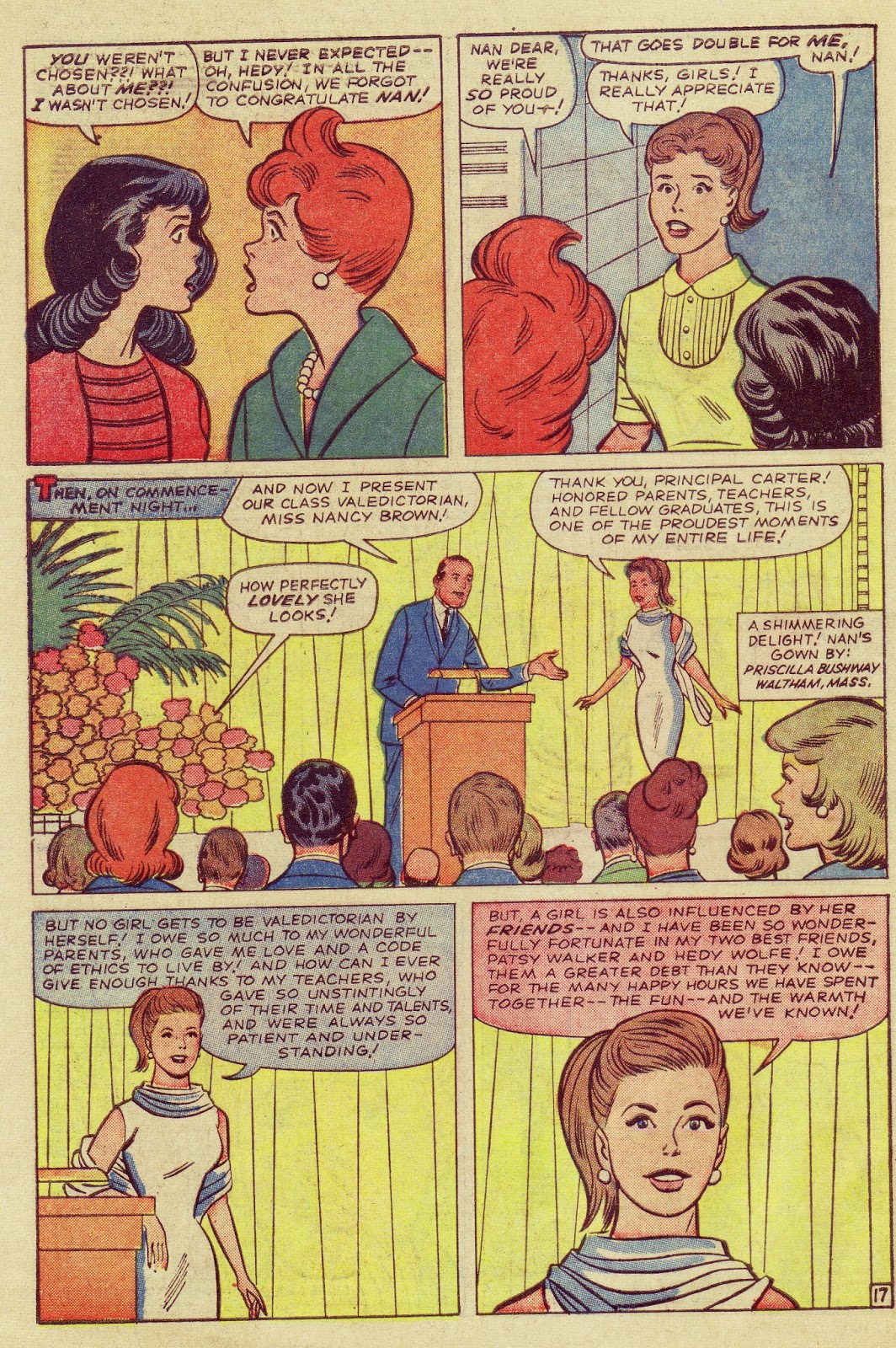
"Patsy's Graduation Day", Patsy and Hedy # 95, August 1964. Stan Lee's stories for the soap opera titles sometimes informed his later superhero work. Patsy and Hedy graduated high school thirteen months before Peter Parker, with the two questioning if they should go on to college or begin a career. It's interesting that Stan did not go the standard rout, avoiding concerns about marriage and parenting, as was usually the case in this period. Sometime later Patsy's boyfriend Buzz became a soldier in Vietnam who came back wounded, storylines that rarely found their way into the more "adult" superhero fare. While the title page only reads "Stan Lee and Al Hartley", the inking is by Chic Stone. While his ink line is not as distinctive as it is on Kirby's work (which was concurrent with FF # 29 and Journey into Mystery # 107), there are some tell-tale signs, such as his inking on hair and clothing. Letters by the prolific Artie Simek.


An early Roy Thomas script. While there is a credit box on the splash page, it reads "Edited by Stan Lee; Written by Roy T.; Art by Stan G." Inking here is by Sol Brodsky. Sol's inking has a very clean, crisp look, evident in the faces of the figures in panel one, as well as the clothing in panel four. While Sol's main function in this period was in production, he also wrote scripts for the girl titles on occasion, as well as pencilled and inked strips on westerns as well. From Modeling with Millie # 45, February 1965. The cover to this issue features a Millie face by Jack Kirby, for the story behind that read my earlier blog post here: 

http://nick-caputo.blogspot.com/2012/07/unaltered-cover-to-modeling-with-millie.html


Frank Giacoia adds his attractive brush to Stan Goldberg's pencils, with Sam Rosen letters and likely Stan G's coloring as well. Roy Thomas authored the story featuring the Gears, a rock group who are referred to on the cover as "cooler than the Beatles and kookier than the Kinks!" Roy confirmed that he wrote the cover copy, which I surmised, since I doubted Stan would know who the Kinks were! From Millie the Model # 135, February, 1966.


In "Cherleading, Millie Style" John Tartaglione provides the inks. The lines on Millie's cheek in panel four is indicative of Tartaglione's style. Mr. T was then inking Sgt. Fury, Daredevil and X-Men. Script credited to Denny O'Neil (as Denny O.) Stan G. pencils and likely colors, with lettering by Morrie Kuramoto. From Millie the Model # 146, February 1967.  

  
 Bill Williams penciled a few Millie stories in 1967, although he drew many strips over the years for Dell, including Henry Aldrich. When I first saw Williams art I though it was actually the work of Tom Sutton, whose style bears some similarities to Williams (Sutton began working for Marvel in 1967). Williams is credited on the splash, along with writer Gary Friedrich, but the inking is by an old Timely-Atlas veteran, George Klein. While there is not a lot to go by in this story, I noticed his ink line, specifically on clothing and hair. Lettering looks like it may be by another newcomer to Marvel in '67, John Verpoorten, who initially did a little drawing, lettering, inking and became Marvel's production man. "Someday, My Playboy Will Come" from Millie the Model # 151, July 1967. The cover, incidentally, is by Ogden Whitney, who worked for Marvel for a short spell, drawing a Shield story, a run of Two-Gun Kid stories and a few Millie covers.


While I struggled to discern Klein's distinctive inking traits in the first story, since, like a few other inkers, pretty much traced over the pencils, I was surprised to discover that the third story actually had a Klein inking credit! (uncredited lettering by Morrie Kuramoto). As noted, this was a rarity and may have been added accidentally, since Klein was still working for DC in 1967. It would be a year or so later when Klein's inking graced the superhero line, over artists such as Gene Colan, John Buscema and Jack Kirby, and fine work it was.


Mike Esposito's inking is usually easy to identify. He has a very light line as evidenced on the faces, clothing and hair on this page. Esposito was also inking the "Iron-Man" and "Hulk" strips this month. Stan Goldberg pencils?; writer unknown (there were no credits in this final issue of Patsy Walker, # 124, December 1965, although its likely either Al Hartley, who wrote many of the previous issues, or Denny O'Neil, Gary Friedrich or Sol Brodsky wrote the story; Roy Thomas told me he didn't script this issue, but did write the final issue of Patsy and Hedy). Patsy was likely replaced on the schedule by Fantasy Masterpieces, which debuted the following month) but it is worth noting that the fashions are credited to one Tara Jean Thomas, of Jackson, Mo. Roy's sister!

I'm not entirely sure of the inker on this story, although it reminds me to some degree of George Roussos. It doesn't look like he had any concurrent work for Marvel at the time, but its possible he helped out occasionally. From Patsy and Hedy # 105, June 1966. Denny O'Neil story; Stan Goldberg pencils; Sam Rosen letters.


Splash page to Chili # 8, December 1969 

The mid-1960's were not kind to Marvel's soap opera line. The long running Patsy Walker was the first to get the ax; the final issue was # 124, December 1965. Patsy and Hedy continued a while longer, until # 110, February 1967. Modeling with Millie followed four months later, with # 54, June, 1967. They were replaced on the schedule with the likes of Ghost Rider and Not Brand Echh. The flagship title, Millie the Model, survived, although the October 1967 issue (#154) instituted a change. 

With soap opera dramatics floundering, Publisher Martin Goodman likely ordered Stan to follow in the footsteps of the popular Archie line. This was actually a return to Millie's original humor format, and it apparently sold well enough, since it was followed by similar product in early 1969 (April and May dated comics) Mad About Millie and Chili. Marvel continued to issue similar new and reprint material into the early 1970's. Stan Goldberg, was quite comfortable returning to the bigfoot style, although inkers continued to remain anonymous. Chili # 8, Dec 1969, has a Stan Lee and Stan G. byline, although I'm certain it was inked by none other than Bill Everett.    


As noted earlier, the simpler styled art in these stories does not leave lots of room for an inker to add many flourishes. Still, there are little touches that I thought would be interesting to point out. The sharp lines in the sky-line and building, as well as the shadow on the street was something I've seen in other Everett inked strips.


Everett also appears to have inked the second story, "When the Joint Starts Jumping!" The final panels figure on the lower left has distinctive inking on the shirt.


Everett likely inked three out of the four stories in this issue. The last story, "The Livin' End!" features little touches on the taxi and point to Everett's contribution. Throughout the issue there are several signs that Everett was the inker, including his way of inking hair. 

While this is only a small sampling of the many uncredited inkers that worked during Marvel's prime period I hope to discover more in the years head. I'll be sure to report more such discoveries in future blog posts.

With an "Officer Joe Bolton" tip of the hat (it's an inside joke!) to Doc V, aka Michael J. Vassallo, fellow Yancy Streeter and one of the shining lights of comics fandom.        
          

Tuesday, July 9, 2013

New Splash Pages in Marvel Reprints

In the 1970's Marvel published a great many reprint comics, and along with the superhero material that appeared in Marvel Tales, Marvel Super-Heroes and Marvel's Greatest Comics, they also reprinted a huge amount of genre material: war, western, horror, monster, jungle, romance and humor. While I've discussed new material that appeared, such as pin-ups or original stats of covers, I've also discovered a few examples of new splash pages that replaced the originals.


While this may look like a Strange Tales cover, it's actually the splash page with new lettering by Morrie Kuramoto. Monsters on the Prowl # 22, April 1973.  
 
The splash page for "The Thing Runs Amok". A number of alterations differ in the reprinted cover image. The title is changed to "Monster "so as not to have any tykes confused by Marvel's curmudgeonly member of the Fantastic Four who bears the same name. The reprinted cover also had the monsters right arm and hand redrawn, and added cover copy, word balloons and buildings in the background. The monsters eyes are also eliminated, giving him empty "Little Orphan Annie" sockets instead. Jack Kirby pencils; Dick Ayers inks.  

When it was decided to reprint the original cover to Strange Tales #93, "When The Thing Runs Amok" some changes were made. Monsters were popular sellers at Marvel in this period, so it made sense to re-publish many pre-hero stories.  The original covers were often used, but artists such as Gil Kane and Jim Starlin were also commissioned to provide new artwork. In the case of the above story there was no original cover to accompany it, since the cover to Strange Tales # 93 broke tradition and skipped using a scene from the lead story, instead focusing on a Lee-Ditko back-up story.


Cover to Strange Tales # 93, Feb 1962 representing the Lee-Ditko back-up story. Kirby pencils; Ditko inks, Artie Simek letters; Stan Goldberg colors.

Interestingly, "The Wax People" was also reprinted in Monsters on the Prowl # 22, so it COULD have been used as a cover image. However, the reasoning seemed to be that monsters sold better than fantasy, and since the comic was titled MONSTERS  on the Prowl, - a monster - instead of menacing wax figures was settled on.

   The decision to use the splash page as the cover image led to another dilemma - the need to replace the old splash with a new one.


The new splash page artwork is penciled by Rich Buckler (thanks to Steven Thompson for the conformation) with inking likely by Mike Esposito. Buckler was drawing many covers for Marvel in this period, which leads me to wonder if the splash was originally prepared to be used as the cover image instead. A logical guess, with an obvious answer why it wasn't after some thought. Buckler's monster is facing away from the reader. In the past a number of covers were rejected by either Stan Lee or Publisher Martin Goodman when a major character was seen from behind. At this point Lee was publisher and either he or de facto art director John Romita may have vetoed the scene. The problem was easily solved by exchanging the images, using Kirby's splash instead. 


New splash page for "The World Below", pencils by John Byrne, inks by John Tartaglione, lettering by Jim Novak. 

The next instance of a new splash page is clearly deliberate. Dr. Droom, the short lived occult hero who occupied the pages of Amazing Adventures in 1961, was revived and reprinted in 1976, now renamed Dr. Druid, to avoid confusion with Stan Lee and Jack Kirby's premiere villain - Dr. DOOM. Roger Stern presided over the reprints in Weird Wonder Tales (#'s 19-22 starred Druid) and alterations were made in the character's appearance. Dr. Druid also became "host" for the anthology back-ups, with his image inserted on the splash page of stories. For many it was the first time Dr. Droom was discovered, and although it was a minor strip with unfulfilled potential, a fellow named Steve Ditko came along a few years later and created his own mystic hero that went on to greater notoriety. As historian/fan Barry Pearl has noted, it is probably no coincidence that Ditko, who inked the first Druid story, would go on to create a better version. His track record for improving/revising strips includes Iron-Man, the Hulk and the Blue Beetle.  

Since Marvel was using Dr. Druid as a recurring character in the Marvel universe at the time, he was retroactively redrawn with a costume (in the original stories he only appeared in civilian attire), so the splash page was an addition to the story, not a replacement.


The second page (with art by Jack Kirby and Dick Ayers) was originally the splash. The title and some copy was dropped and two panels were added. The first panel of the ship was taken from page 5; panel 5, with a new panel added. The lettering by Jim Novak approximated Artie Simek's original, and with a little tinkering of word balloons and art alterations in panel three the page was completed. 

Roger Stern took great care to produce a different type of reprint title, seeking out interesting material from Marvel's archives and adding a letters page, a rarity in that period. Unfortunately Weird Wonder Tales # 22 was the last issue, and even though, according to Stern's editorial, sales were picking up, monsters and their ilk were waning with the reading public's interests, and the powers that be decided to concentrate on other material.  


Roger Stern's editorial from the final issue of Weird Wonder Tales. Dr. Druid illo by Marie Severin.

In a touch of serendipity, as I was planning out this blog and discussing it with my good friend Barry Pearl he showed me Tony Isabella's quote from Roger Stern about his input. Tony wrote about Marvel's horror/monster reprints, adding some very interesting information. You can read all about it here:

It's fitting to end this look into reprint minutiae with Jack Kirby's final monster cover for Marvel. Kirby produced two of the four Dr. Druid featured covers (Weird Wonder Tales #'s 19-20), but would soon leave Marvel for the final time. His era of monsters and heroes, both large and small, had come to an end. We would not see its like again.


Krang does his part for urban renewal. Jack Kirby knocks it out of the park one last time as the second monster era slowly fades away. Inks by Klaus Janson, lettering by Danny Crespi, Weird Wonder Tales # 18, October 1976. 

Thanks to Barry Pearl and Tony Isabella for their analysis, background info and enthusiasm.

Tuesday, June 11, 2013

The OTHER Kirby Rawhide Kid cover

Following up on my last post I've found another alternate Jack Kirby western cover, this time featuring the Rawhide Kid.

Kirby and Lee created a new Rawhide Kid when  the title was revived with issue 17, August 1960. Aided greatly by the original Rawhide Kid's artist, Dick Ayers, on inks, the new Kid was a success - a veritable James Cagney tough-guy in the west. Kirby worked on the strip for 16 issues, pulled away once he became more important on the super-heroes. He was followed by Jack Davis, Dick Ayers, Jack Keller and, for the longest run, Larry Lieber, who wrote and drew the strip continuously (with occasional fill-in stories by Dick Ayers, Werner Roth, and Paul Reinman) from # 42, October 1964, until # 115, April 1973 when it went all-reprint. Rawhide Kid finally rode into the sunset with issue # 151, May 1979.


Rawhide Kid # 20, Feb 1961, Kirby pencils; Dick Ayers inks

Issue #20 was Lee and Kirby's fourth Rawhide Kid issue. Kirby's cover image of the Kid became iconic, used often on pin-ups, a tee-shirt and cover symbol. The cover is a bit awkward in its construction, with the caption appearing between the Kid's foot and the badman. The lettering is also odd, clearly not the work of Artie Simek and not a recognizable style. What is interesting is that another cover was rejected, appearing for the first time (I'm guessing) at the Dutch company Classics/Williams, which also featured the unpublished Kid Colt cover, as seen in my last post.       


The Rawhide Kid appearing in Sheriff Classics # 997, 1968. Kirby pencils; Dick Ayers inks.

The rejected cover showed up seven years later at the Dutch company. I find this cover image more appealing than the published version. The Kid is the center figure, with only the criminals weapons and hands shown. Like the printed version, the background figures are fleeing. Why was this cover replaced? I can only speculate that Lee or Goodman wanted the villain to be seen.

But that's not the end of the story. The original cover WAS finally published in the states 15 years later, unnoticed and without fanfare.


Rawhide Kid # 136, Nov 1976.

As noted, Rawhide Kid had been a reprint title for a number of years, and the covers alternated between new art, usually by Gil Kane, and reprinted covers. Kirby stories and covers were used beginning with # 134, and while there were some alterations and relettering, they were recognizable as reprinted from the original run. When I first saw this cover I thought it might have been an image taken from the interior, but that was not the case. I was never 100% sure the image wasn't a blow-up from an earlier issue, but when I recently discovered that it appeared as early as 1968, complete with the Black-Jack Borden title, it confirmed that the cover was an unpublished version. 

Perhaps I'll find other such discoveries. If so, I'll be sure to share them here.           
       

Monday, June 10, 2013

Jack Kirby's unknown Kid Colt cover

Over the years I've discovered instances where foreign comics reprinting american stories were provided original stats from publishers. When compared to the printed covers alterations ranged from minor (movement of copy or relettering of a word) to more comprehensive (the Ditko Spider-Man figure redrawn by Jack Kirby: Amazing Spider-Man # 35) . These unaltered stats were sometimes used on reprints in the states as well. Less often, an unpublished cover would be used, usually uknown to most fans. It's always a thrill to find such surprises and compare them to the originals.

The Dutch company Classics/Williams reprinted many Marvel comics in the 1960s and 1970s, ranging from superhero to pre-hero monsters. They also reprinted many of Marvel's cowboy heroes in the comic Sheriff Classics. This title cover featured the likes of Kid Colt, Rawhide Kid, Ringo Kid, Two-Gun Kid (as Twee Pistolen Kid) and Ghost Rider (as, my favorite, De Spookruiter).


Sheriff Classics # 9111, 1968; De Spookruiter cover featured. Originally from Ghost Rider # 2, April 1967, Dick Ayers cover art.


Classics/Williams employed a mixture of styles, included some attractive painted covers and many that copied interior scenes by their own staff, often closely copying the work of Jack Keller, Dick Ayers, Jack Kirby and Larry Lieber. The Grand Comic Book Database has many of these covers on their site, as can be seen here:

    http://www.comics.org/series/19745/covers/

scroll down to view the Kid Colt covers and check the four pages of covers.

While looking through those covers I came upon one that was not familiar to me. I have all the Kirby Kid Colt covers, including those he drew for Gunsmoke Western, and this cover was nowhere to be seen:


Sheriff Classics # 978, circa 1967, published by Classics/Williams. Image from the GCD.

The above cover art is pencilled by Jack Kirby and appears to be inked by George Klein. If the inking is the work of Klein it narrows the period when it might have been produced, since Klein inked Kirby on a number of covers and stories in the early 1960s, including Fantastic Four #'s 1 & 2. It immediately brought to mind a cover that also featured convicts, so I rummaged through my Kid Colt collection. It didn't take too long to find this cover:


Kid Colt # 97, March 1961. Kirby pencils; Ayers inks; Artie Simek letters and Stan Goldberg colors.

This cover also has Kid Colt in shackles and in a prison yard. One can also understand why the original cover was replaced. While the convicts in the foreground and background are well drawn and dramatic, the figure of Kid Colt is awkward. The published cover has perfect symmetry. The readers eye moves along with the convicts to the center figure of a despondent Kid Colt, with two police officers on either side. In the background stand two smaller offices and the prison walls. Dick Ayers' brushwork is excellent, as is Stan Goldberg's use of gray tones on the convicts. Stan Lee places Artie Simek's lettering above the artwork, although the cover could have worked just as well with no copy. The cover is an example of Kirby's ability to create images that draw the reader in. What kid wouldn't want to pick up the comic and read the story inside?      

The unpublished cover is an example that not every design worked. Stan Lee told me he often provided cover layouts for his artists, and he may have done so on these covers. Perhaps after he saw the original he realized it did not have the dramatic punch that was needed. It's entirely possible that the change was made at the directive of publisher Martin Goodman, who knew how important covers were to sales. In this period Kid Colt was a very popular title and strong seller, so it would be no surprise that the cover was scrutinized thoroughly. It's possible Kirby himself redesigned the new cover. Whatever the case, Kid Colt # 97 is an example of a redrawn cover that was improved tremendously in its second take. How many others still exist waiting to be found?              


Friday, May 24, 2013

Easy Reader Says: "This Blog Is Easy To Read"

In my frenzy to index every comic book I get my hands on for the GCD, I recently borrowed issues of Spidey Super Stories from Barry Pearl (whose Pearl's of Comic Book Wisdom Blog can be accessed in the favorites section). Spidey was a co-production of the Children's Television Workshop, known for Sesame Street. The Electric Company was geared to young children, teaching then reading and punctuation skills while entertaining them with skits, animation and music. Included in the cast were well-known performers such as Bill Cosby, Rita Moreno and - before he rose to stardom -  Morgan Freeman. In 1974 CTW added a segment featuring Spider-Man,  although their version never spoke. If I recall correctly they used word-baloons and captions in place of Spidey actually talking. The Electric Company was a popular show, running from 1971-1977. 

Back cover to Spidey Super Stories # 1, Oct 1974. Art by Win Mortimer and Mike Esposito, with some touch-up work by John Romita.

The Spidey Super Stories comic book debuted in the summer of 1974 to coincide with his appearances on the show, produced under the supervision of Children's Television Workshop. The early issues were written by Jean Thomas, drawn by Win Mortimer (Don Heck drew a story in issue 2) and inked by Mike Esposito. Artie Simek and Ray Holloway lettered most of the stories. John Romita drew all the early covers, which were simple, uncluttered and attactive, unlike many of the concurrent Amazing covers, which were often very busy and relied on an abundance of captions and word balloons. Romita's Spidey covers harkened back to his exceptional mid-1960s work, when Marvel relied more on strong images to sell a cover.

Spidey Super Stories # 6, March 1975. Cover by John Romita and Mike Esposito.

It was fun to look through these stories. They were, of course, prepared for a younger audience, but Win Mortimer, a long-time pro who drew everything from Superman and Batman to romance stories, had a style that complimented the material. The storytelling was clear and simple, and Mortimer's poses often showed the influence of Ditko and Romita, who he clearly looked to for reference.

Back cover to Spidey Super Stories # 14, Dec 1975,by Win Mortimer and Mike Esposito.


An example of Win Mortimer's storytelling skills. While his art was not flashy and did not fit into the "Marvel" mold, he was well-suited to realistic settings and people. Nevertheless, he did a fine job molding his skills on Spidey Super Stories. Inside back cover to issue 17, July 1976.     

Here is a link to view Mortimer's pencils, from the back cover of Spidey # 14:


Included in many issues were feature pages such as this one, based on a similar scene that appeared in Spider-Man Annual # 4. Most of the feature pages were redrawn versions of the Ditko pages which explained Spidey's powers, as seen in Amazing Spider-Man Annual # 1. From Spidey Super Stories # 2, Nov 1974. Jean Thomas script; Win Mortimer pencils; Mike Esposito inks, Artie Simek letters.

The format for Spidey Super Stories usually included three stories per issue, with one an adaptation of an Electric Company Spidey story. The comic was 36 pages long, had no ads and was priced at 35 cents. 

While there were no outside ads in Spidey Super Stories, the back page was often used to promote subscriptions. Here Spidey and Easy Reader do the honors. Art by John Romita; letters by Gaspar Saladino. 


John Romita rendered some attractive illustrations in these ads. Spidey Stamps were similar to Marvel Value Stamps, with many drawn by Romita. Back covers to  Spidey Super Stroies #'s 18 and 24. Lettering by Irv Watanabe.

The inside front covers and sometimes the interior feature pages were often used to provide background on the villains and guest-stars. Here, Lockjaw, a popular character in the "Spidey universe" is featured. Win Mortimer pencils; Mike Esposito inks; Ray Holloway letters. Script by either Ralph Macchio or Kolfax Mingo (which is very likely a pseudonym). Spidey Super Stories # 24, July 1977. 
  

In some respects the title was similar to Marvel Team-Up, since most issues had Spider-Man meeting a Marvel hero. Medusa, Iceman, Shanna, The Cat, Falcon, Storm and Captain America were introduced to the younger set, and issue # 16 included a team-up that never occurred in the Marvel Universe....


Spidey Super Stories # 16, April 1976. John Romita cover.

No this wasn't a cross-over with the famous Steven Speilberg film! Since Jaws was such an overwhelming box-office hit, comics took advantage and utilized sharks on covers to promote sales. The obvious guest was the undersea hero Sub-Mariner, although he was only referred to as Namor, perhaps because it was thought to be an easier name for kids to pronounce. The unexpected co-star turned out to that granddaddy of cowboys, Kid Colt Outlaw.
     

Spider-Man Meets Kid Colt, Jim Salicrup script; Win Mortimer pencils; Mike Esposito inks. Ray Holloway letters. 


In the "Spidey" universe Lockjaw can teleport through time. He takes Spidey and the Electric Company to the past to clear Kid Colt's name. Interestingly, four months prior Steve Englehart had the Avengers travel to the past for Marvel's first cross-over with their western heroes in a story illustrated by George Perez and Vince Colletta. In that tale the Avengers met Kid Colt, Rawhide Kid, Two-Gun Kid, Ringo Kid and the Ghost Rider (Avengers #'s 142-143; Dec 1975-Jan 1976). I always enjoyed the Marvel westerns and was thrilled when Englehart brought them into the lines continuity. While there were requests in the letters pages from time to time for a cross-over, editor Stan Lee kept the line separate. When Roy Thomas took over editorial he was more open to the idea. George Perez was an energetic and talented young artist recently assigned to the Avengers and while he did a fine job illustrating the story, in retrospect Don Heck (who had recently been replaced by Perez on The Avengers) would have been a more perfect fit, as his efforts in the genre were particularly inspired. It would also have been interesting to see his interpretation of the characters, since he rarely worked on the lead characters. But I digress...


I asked writer Jim Salicrup about this story, thinking perhaps he was influenced by Englehart's story, but he replied that using Kid Colt's appearance may have been requested by Children's Television Workshop. Salicrup thought that perhaps they noticed the Avengers story and figured it might be interesting to use Kid Colt.  Salicrup worked on Spidey Super Stories for some time, usually with Win Mortimer and Mike Esposito. He recalled that the folks at CTW were pleased with Mortimer's work and Salicrup noted that he was a gentleman. 

Other creators that worked on Spidey included Byron Preiss, Ralph Macchio, Nick Cuti, Bill Mantlo and Dave Kraft (scripts); Don Perlin and Riccardo Villamonte (pencils and inks, respectively);and Tony Mortellaro often assisting Mike Esposito on backgrounds. Later covers featured the work of Sal Buscema, Al Milgrom, Dave Cockrum and even Jack Kirby on a cover or two!


Even Thanos got into the act! Spidey Super Stories #  39, March 1979. Al Milgrom pencils ?; Sal Buscema inks ? Image from the Grand Comic Book Database.

Spidey Super Stories continued until # 57, March 1982, a solid eight year run. While researching I was surprised to learn that the Electric Company also produced its own magazine, which included 4-5 page Spidey stories in many issues, a few illustrated by John Romita as recorded here:  https://www.spiderfan.org/title/comics/electric_co_mag.html

Writers and artists on these stories included Len Wein, Marv Wolfman, Steven Grant, Sal Buscema, Jim Mooney and Alan Kupperberg. The magazine ran longer than the comic, lasting into the late 1980s.   

 While rarely mentioned when discussing Marvel's 1970s line, Spidey Super Stories was an example of the growing influence the characters had outside of comics. Like the earlier 1967 animated series, Spidey took the strong foundation of the Lee, Ditko, Romita era characters and simplified them for a younger audience.     


The Impossible Man pops up in a back page ad from Spidey Super Stories # 25, Aug 1977. Art likely by Al Milgrom. 


With special thanks to Gentleman Jim Salicrup and Bashful Barry Pearl.